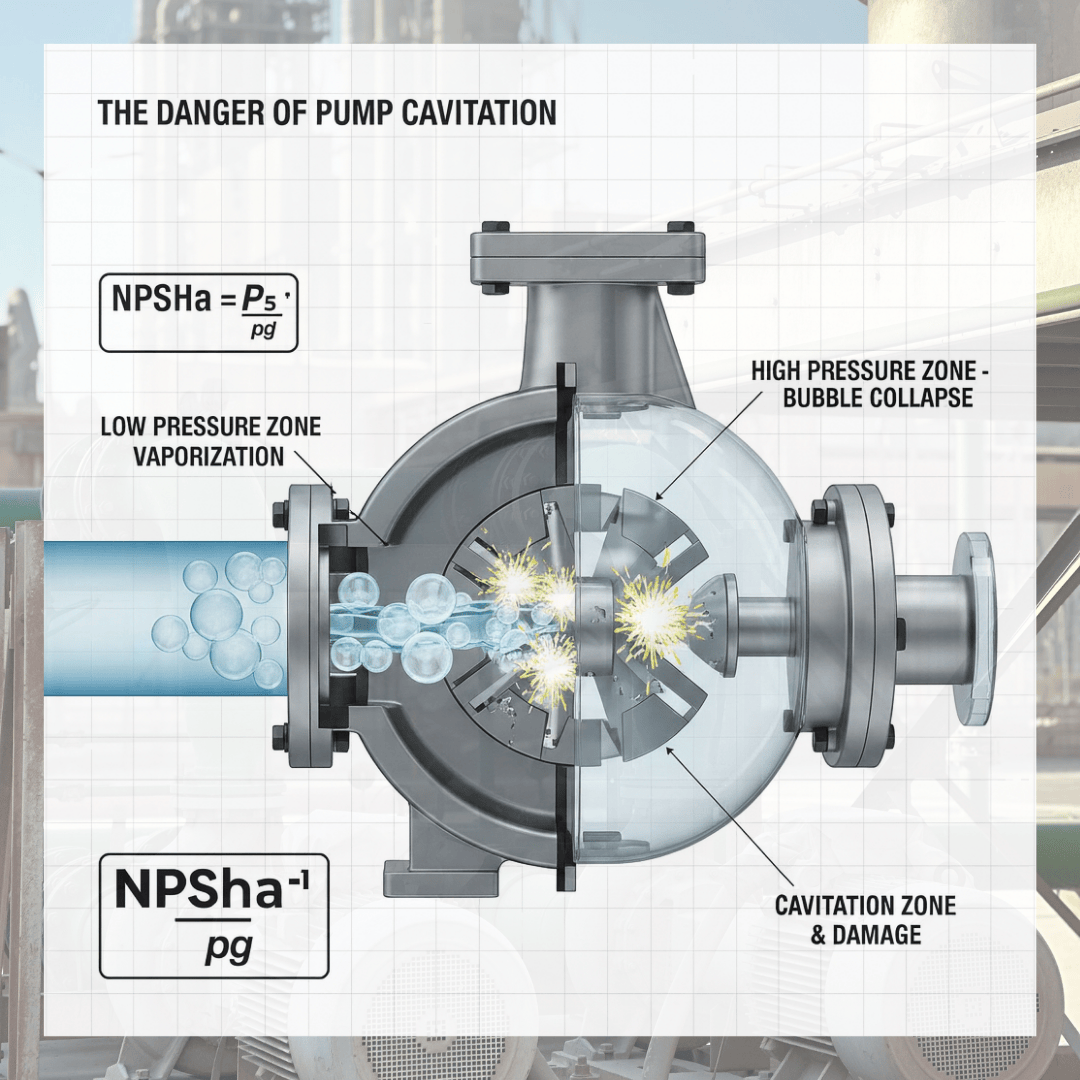
Net Positive Suction Head (NPSH) is one of the most important concepts in pump engineering. It helps us understand whether a pump will run smoothly or face problems like cavitation, which can damage the pump. When students and engineers learn NPSH in simple language, they can easily design safer and more efficient pumping systems.
What is NPSH?
NPSH tells us how much pressure is available at the pump suction compared to the liquid’s vapor pressure.
If this pressure is too low, the liquid starts boiling inside the pump. This creates bubbles that collapse violently — a process called cavitation.
Cavitation causes:
• Noise and vibration
• Damage to impeller
• Reduced flow and head
• Short pump life
So, calculating NPSH correctly helps us avoid cavitation and keep the pump healthy.
NPSH Formula
There are two types of NPSH:
1. NPSH Available (NPSHa)
This is the pressure actually available at the pump suction.
NPSHa = (Ps - Pv) / (ρ × g) + Hs - hf
Where:
• Ps = Suction pressure
• Pv = Vapor pressure of liquid
• ρ = Density of liquid
• g = Acceleration due to gravity
• Hs = Static suction head (positive) or lift (negative)
• hf = Friction losses in suction line
2. NPSH Required (NPSHr)
This is the minimum NPSH the pump needs to avoid cavitation.
It is provided by the pump manufacturer.
Golden Rule:
NPSHa > NPSHr
If NPSHa is less than NPSHr, cavitation will occur.
Why NPSH calculation is important?
• Ensures smooth pump operation
• Prevents cavitation damage
• Increases pump life
• Reduces maintenance cost
• Helps in selecting correct pump and piping design
• Improves safety and reliability of the system
For industries like chemical, water supply, oil & gas, and HVAC, NPSH is a critical design parameter.
|Best Process Engineering Institute in India|
|Petromech-Best Process Design Institute|
|Chemical Process Engineering Course|